THE ORIGIN OF LIFE
In the beginning was the machine…
For my solo exhibition at Beaconsfield Gallery I made an an interactive sound installation utilising twenty-one second hand synth keyboards. Flaccid rubber ‘fingers’ concocted random symphonies triggered by the movement of visitors around the creaking gallery floors, in an automated parody of creative autonomy and vitalist impulses.
The Origin of Life at Beaconsifeld Gallery
The Origin of Life, mixed media kinetic sound installation, 2019 (All installation photos: Joe Walsh)

The Origin of Life, mixed media kinetic sound installation, 2019

The Origin of Life, mixed media kinetic sound installation, 2019
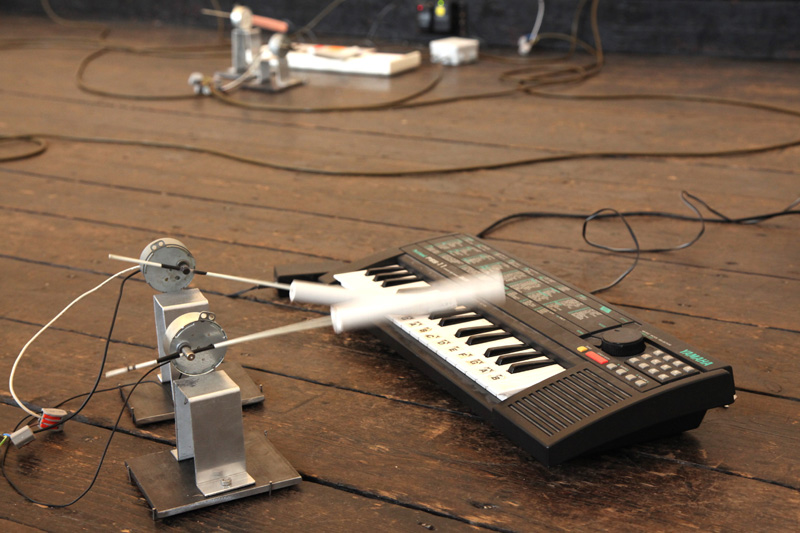
The Origin of Life, mixed media kinetic sound installation, 2019

The Origin of Life, mixed media kinetic sound installation, 2019

The Origin of Life, mixed media kinetic sound installation, 2019
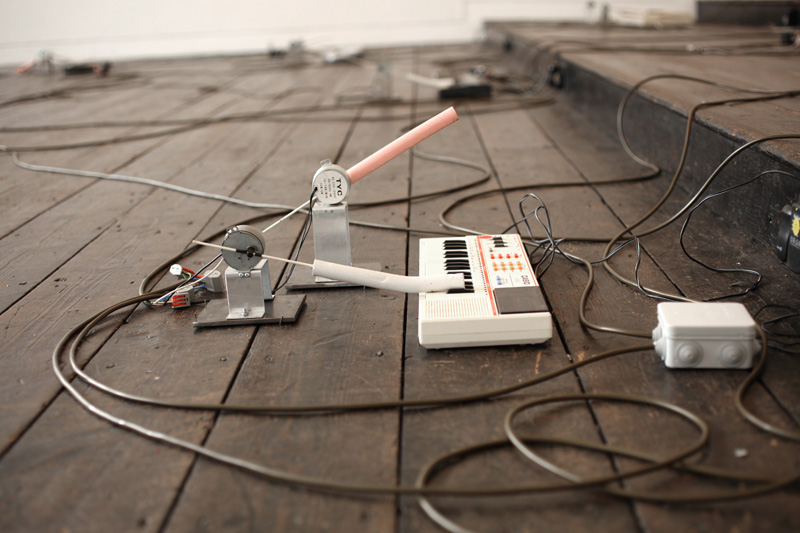
The Origin of Life, mixed media kinetic sound installation, 2019

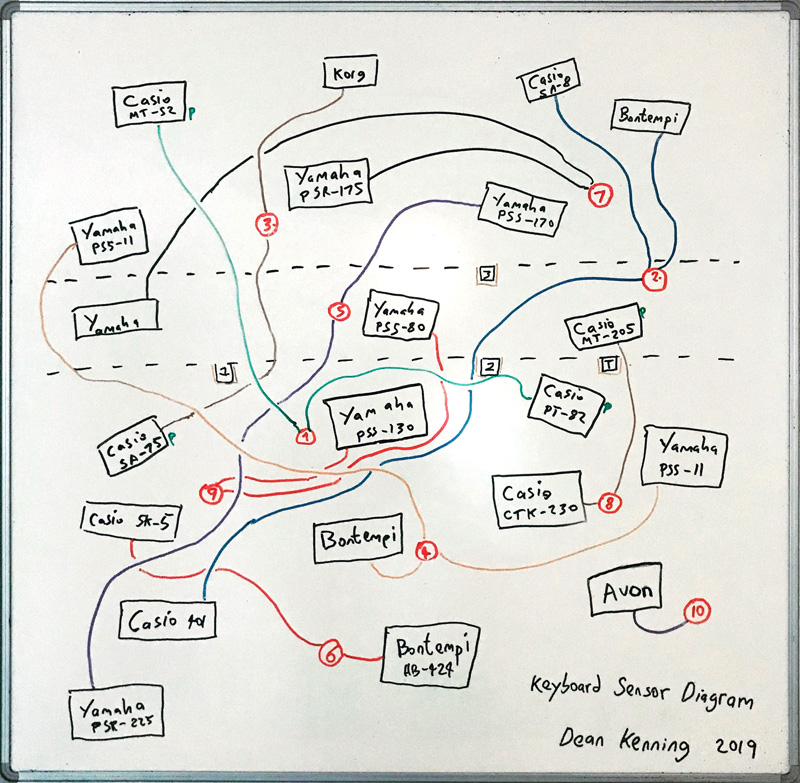
Keyboard Sensor Diagram, 2019
'Dean Kenning's Stuck Machines', a talk with the artist Emma Hart about my kinetic sculptures, is available to listen to here
Listen to my interview about the exhibition with Simon Tyszko on Resonance FM here
An extract on The Origin of Life from John Robert's essay 'Dean Kenning's Kinetics':
'But, if the deflationary logic of these DIY ghost-practices appeals to ‘failure’ as the subfusc truth of technological progress, this sense of loss also enables the artist to draw significantly on another sense of loss, the relationship between technology and (surplus) jouissance: that is, the notion of technology - in its deathly passing - as a dead realm of desire, or more generously, trapped desires unable to attach themselves to new drives. And it is precisely this sense of ghostliness, that Dean Kenning has been concerned with in his own kinetic refunctioning of old machines and machine parts. His investment in ‘moving art’, more broadly, accordingly, is less the result of idiosyncratic eco-tinkering, than a re-assimilation of machines as things that were once drivers of surplus-jouissance, and as such, things that had, not just a functional, but an imaginary hold, over lives. This is strikingly evident in his recent large kinetic-‘musicological’ installation ‘The Origin of Life’ at Beaconsfield in South London (March-April 2019). Kenning distributed throughout the slightly sloping floorboards of what was once the Lambeth Ragged School, 21 small electronic keyboards (including one analogue synthesizer) from the 1970s, 1980s and 1990s (Bontempi, Korg, Casio and Yamaha). A number of motion sensors placed inconspicuously around the gallery floor triggered thick, white, silicon rubber ‘fingers’, one or two per keyboard, that then repeatedly struck the same notes in a kind of manic persistence. As such, if you moved quickly through the space, navigating various routes, you could trigger all the ‘fingers’ simultaneously creating a cacophonous overlapping of clusters of repeated notes. When the cacophony dissipated, invariably there would be one or two ‘fingers’ that would have switched off in the act of depressing a key and so certain notes persisted longer than the rest, as if they were urging the other keyboards to continue. Indeed, this forlornness is what remained most distinctive about the installation, particularly when the sound of one keyboard faded to be replaced by another and then another, in a kind of desperate and diminishing chorus of sonic assertion. The human-aided discontinuity or broken temporality of the sound, consequently, produced a distinctive user-work relationship. Rather than ‘turning on’ a pre-set system, the triggering of the sensors produced a strange intersubjective relationship with the ‘fingers’, as if the visitor was less the audience, than the ‘other’ of the ‘fingers’ desire. Thus, it felt as if you were giving life to the ‘fingers’ in order that they could persist in their slightly demented need to make a noise at all costs, before, blackness and silence descended again. This is why the forlornness of the solitary ‘fingers’ banging away for all they were worth, felt like a kind of pleading from inside the death-drive of technology, as if the ‘fingers’ were the last bodily remnants of a jouissance barely recognisable as jouissance, given that desire in this fragmented state was now embodied in the nonhuman and thus unable truly, fully to attach itself to its own autonomous drives.
This interface between the nonhuman and human gives the kinetic dynamic of ‘The Origin of Life’ its peculiar force and wild, anxious, ‘subjectivity’; machine and rote, mechanized desire, are brought to repetitive, frustrated, splenetic life by the unconscious sadism of the visitor (“play, play, play”; “entertain me”); and, as such, what appears to be given life ‘intersubjectively’, is in the end, sustained by non-reciprocity. The visitor brings the ‘fingers’ to life, but only, as a repetitive exercise. This is why the imputed musicological content of the piece is perhaps misleading; even if the structure of the work owes a formal debt to a post-Cageian, aleatoric aesthetics, the ‘aesthetic’ outcome of the sound patterns is incidental to the staging and impact of the ‘fingers’ ghostly jouissance. Indeed, the ‘fingers’ announce their fading desire not just as the amnesiacal and broken recovery of lost musical horizons and pleasures (of good times, spent in the presence of ecstatic ‘repetitive beats’; of clubs now closed and deserted), but as a kind of self-brutalizing libidinal entrapment; that is, the frenetic and repetitive outbursts appear to ‘reason desire’ back into the ‘same’, rather than give up the desire of desire for one moment. And this of course, is where the disenchantment, repetition and pain of jouissance, under capitalism intersects, at its most intense, with the utopian; or at least its dulled memory.
This relationship between the uncanny and unexpected life in the inhuman human-like body-fragment is well known. Getting robot-like machines or machine parts to perform human-like actions, is denaturalizing in precisely this uncanny way; and Kenning’s keyboards as broken ‘desiring-machines’ do this beautifully: the pleading, ‘forgetful’ repetition of the sounds, appears unbearably close to a call for love, insofar as the mechanical ‘fingers’ mimicry of (barely functioning) human drives, demands from the respondent an immediate, affective response. Indeed, the response to this call is the basis of the work’s uncanny technological-sadistic relation: “I’m still lovable, look what I can do”. “Talk to me” says the talking doll. “Play me, play me, I haven’t forgotten,” says Kenning’s keyboards. Getting Kenning’s ‘fingers’ to move then is ‘irresistible’ to the visitor, precisely because the stomping of feet gets us to take a pleasure from the hubristic overcoming of the past, at the same as the ‘fingers’ asks us to listen to the fragile but persistent ‘voices’ released by the superseded technologies. And this is why ghost-kinetics and the charms of physical, machinic animation in art, remains, such an uneasy, even queasy, affective experience; the broken, DIY machine, wants you to be its friend, so to speak – to get you to see through the technological sadism of the ‘new’ - even, when, as in the case of Kenning’s sad, floppy ‘fingers’, all you want to do is punish it for its, sickly pleading presumptuousness, and, as such, run a mile from its demand for love.'
For the full essay, comissioned by Matt's Gallery for my exhibition Psychobotanical, click here